If you’re planning a major renovation in Atlanta, the bid you compare last is rarely the bid you should pick. The questions you ask before you sign separate the contractors who actually finish jobs from the ones who run out of money halfway through framing.
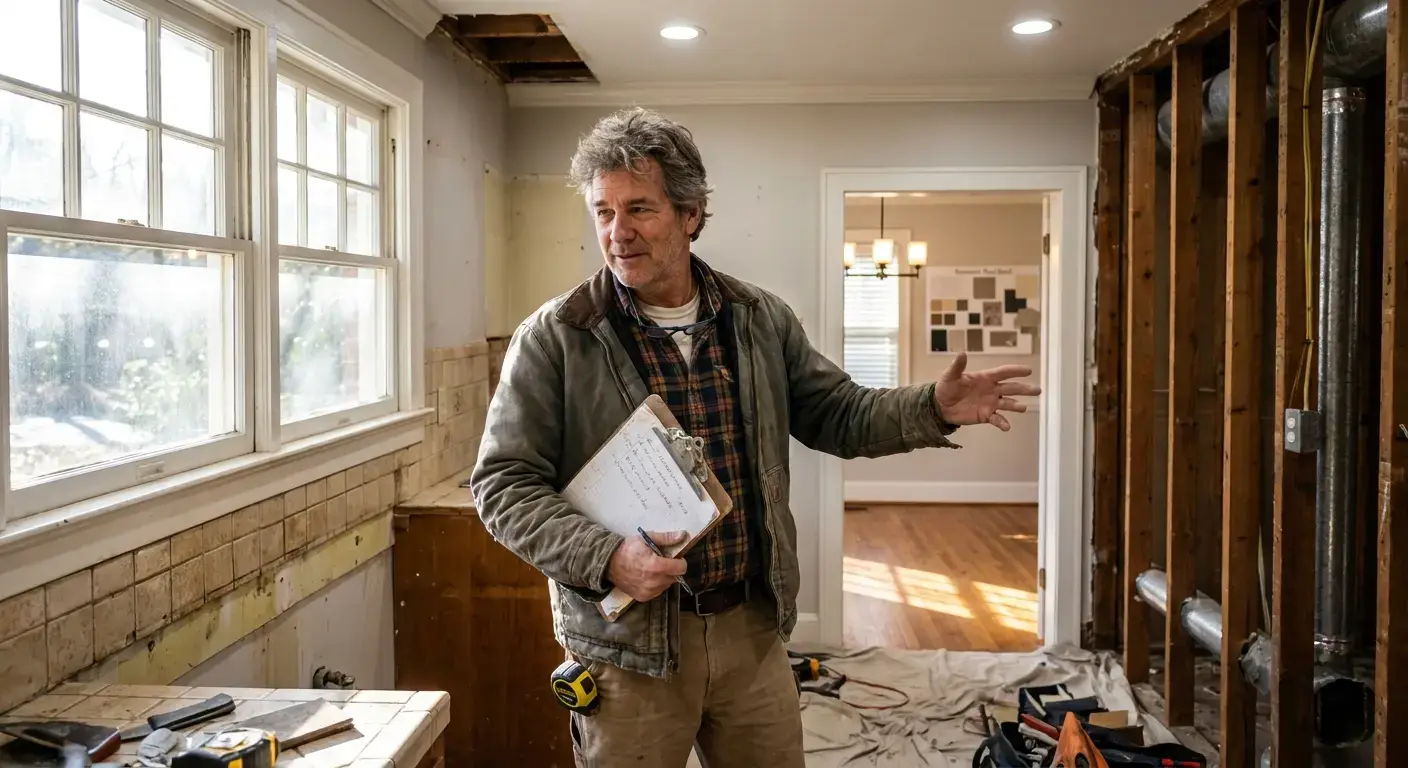
Here are the questions we wish every homeowner asked us. Not because we have rehearsed answers. Because the answers tell you whether the contractor you’re talking to has done this work before, or whether they’re learning on your house.
1. Walk me through your change-order process
Every renovation has changes. Wood rot shows up behind a wall. The homeowner decides to upgrade the cabinets. The plumbing inspector flags something. These are normal.
What is not normal is finding out about the cost at the end.
Ask the contractor: when something changes mid-project, what is the process? Who writes the change order? Who signs it? When does work stop until it’s signed?
The good answer is specific. Written change order, cost locked before work proceeds, signed by you, signed by the contractor, attached to the master contract. The bad answer is vague. “We’ll work it out as we go.” That’s how budgets blow up.
2. Show me your last three projects of similar scope
Not photos from their website. Actual project documentation. Schedules. Estimates. The change orders that got signed.
A serious contractor on a six-figure renovation should be able to show you the bones of three recent projects, with redacted client information if needed. If they can’t, either they haven’t done work at that scope, or they don’t document it. Both are problems.
We use CompanyCam to document every project, every day. Every wall, every system, every install gets photographed and tagged. When a past client calls us two years later asking what we used behind the shower tile, we know.
3. Who is my point of contact, and what happens when they’re sick
On a small job, the answer can be “the owner.” On a major renovation, that answer is a red flag. Major projects need a dedicated project manager who is in the field, who knows your project, and who has a backup when they’re out.
Ask: who runs my project day to day? Who is their backup? How do I reach them if something is wrong on a Saturday?
If the answer is “just call the office,” that’s not a project manager. That’s a phone tree.
4. What is your scope document going to look like
A real scope is not a one-page bid with a total at the bottom. A real scope is a line-by-line document covering every system, every finish, every spec. It tells you exactly what is included and exactly what is not.
The bid that comes in lowest is almost always the bid with the thinnest scope. What’s not in the scope is not in the budget. And what’s not in the budget shows up later.
Ask to see a sample scope document before you commit. If the contractor can’t produce one, they’re going to start your project with a handshake and end it with a fight.
5. What’s your insurance, and can you send me the certificate
General liability. Workers comp. The amounts. And the COI sent directly to you from the insurance carrier, not a photo of an old certificate.
On a major renovation, your homeowner’s policy is not going to cover a worker getting hurt on your property. The contractor’s policy is. Verify it before work starts, not after.
6. Who pulls the permits
You want the answer to be “we do, and we don’t start until they’re approved.”
If the contractor asks you to pull the permits as the homeowner, that means they want the liability on you instead of them. That’s not how a real general contractor works.
7. What does your payment schedule look like
A reasonable schedule for a major renovation looks something like: deposit at signing, draws tied to specific completion milestones (demo complete, rough-in complete, drywall complete, etc.), and a final payment held until punch list is signed off.
What’s not reasonable: a contractor who wants 50 percent upfront, or who wants to be paid weekly regardless of progress. That structure protects the contractor from quitting and protects you from a contractor who needs your cash to fund someone else’s project.
8. What is the inspection schedule
Major renovations in Atlanta require multiple inspections. Framing. Electrical rough. Plumbing rough. HVAC. Insulation. Final.
A good contractor knows the inspection schedule before they bid. They know which inspector covers your area. They know what that inspector is going to flag. They build the schedule around inspection lead times.
If the contractor doesn’t know the inspection schedule offhand, they haven’t done a project in your neighborhood recently.
9. What happens if you go over budget
Get the answer in writing. Most reputable contractors will eat overages caused by their own mistakes (a sub who underbid, a framing crew who had to redo work). They will pass through legitimate scope changes via signed change orders.
What you don’t want is a contractor who treats every surprise as a change order and every change order as your problem. Ask specifically: if your subcontractor underbids and walks off the job, who pays to finish that scope?
10. Why should I pick you over the two other contractors I’m meeting
This is the one most homeowners don’t ask, but should. Not because the answer matters by itself. Because the way the contractor answers it tells you who you’re working with.
The contractor who says “we’re the cheapest” is selling on price. They will cut something to hit that number.
The contractor who says “we just do good work” is selling on vibes. That’s not a process.
The contractor who walks you through their actual differentiator (documentation, scope discipline, in-house project management, response time, written guarantees, named past clients) is selling on substance. That’s the one you want.
How to use this list
Print it. Bring it to every contractor meeting. Ask every question to every contractor. Take notes on the answers.
When you compare bids, you’re not actually comparing prices. You’re comparing the contractor who’s going to be in your house for the next four to twelve months.
The bid number matters less than the answer to question 9.
If you’re planning a major Atlanta renovation in 2026 and want to start with a conversation, not a quote, book a site walk-through. We’ll come look at the project, talk through what we’d do and how we’d structure it, and put the scope on paper before anyone signs anything.